
By Rev. Adam Anderson
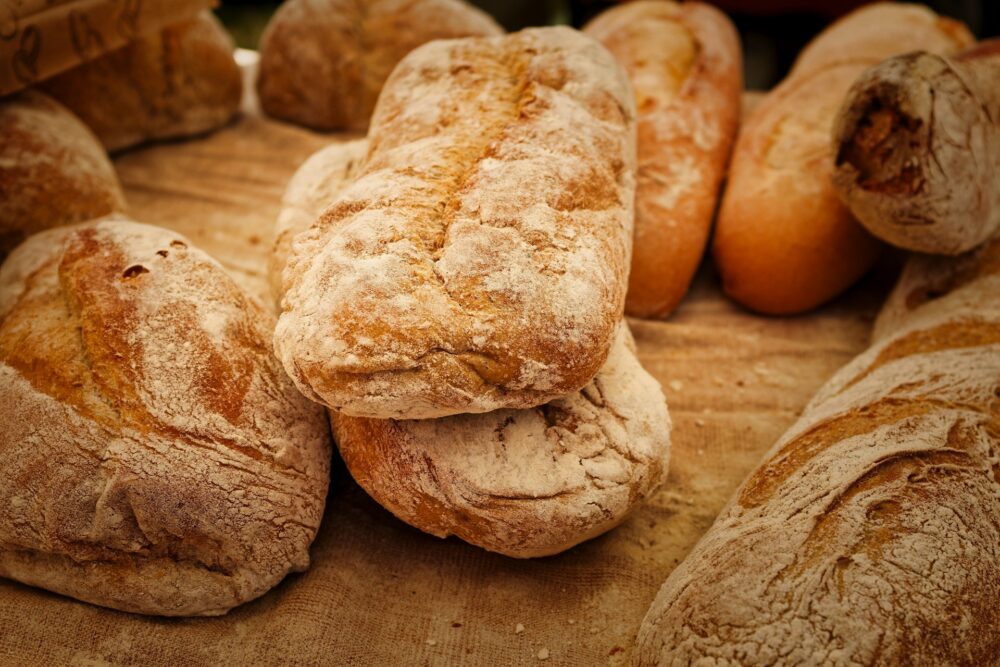
All day today, the same thing is happening everywhere. I kind of let the cat out of the bag at the children’s sermon. This is happening in Nairobi and in Seoul, in a cathedral in São Paulo and a house church in Lahore, and in a Presbyterian church on the corner of San Marco Square. Somebody is tearing bread.
It is World Communion Sunday. On this Sunday, the church all over the world is doing the one thing Jesus told us to keep doing.
And I will tell you, probably in all of the years that I have preached, this might be one of the first times I’m giving us only one verse this morning. Just one, here in First Corinthians. I’ll say it again.
Because there is one bread, we who are many are one body, for we all partake of the one bread.
Listen to how that sentence is built. Because there is one bread. Paul doesn’t say, be one body, and then you’ll earn the bread. He doesn’t say, work hard at unity and then the table will follow. No, he doesn’t say any of that. The bread comes first. The body comes from the bread.
Because, friends, we are not one because we are kind. We are one because we have been fed.
This morning, we are beginning a season together, and we’re exploring an idea of unreasonable hospitality, because I, along with the session, believe it is going to define who we are over the next few years. But before we are anyone’s hosts to lavish hospitality, we are first guests. No one in this room set the table.
To hear why that matters, you have to go to Corinth. The church there, the one Paul writes to, met in houses. These would have been the bigger houses, owned by the members who could afford them. Scholars believe that Roman houses themselves were built around distinctions of status, and some spaces, like the dining rooms with dining couches, were more privileged than others.
A chapter later than where we find ourselves today, Paul tells us what one of the meals in Corinth had become. Some had eaten their fill, and some who got there a little early were already drunk. Then there were the late ones, which was not unusual, the ones who had been laboring in the fields. The one who didn’t have the luxury of privilege walked in hungry to an emptied table, with each person, Paul says, going ahead with their own supper.
Nobody in Corinth thought they were doing anything wrong, because this was reasonable. This was what the culture encouraged at the time. It was the way you would throw a dinner as a part of the Roman Empire there in Corinth. I would have done it as well.
And Paul has already given his answer to all of that reasonableness. One small word. One bread.
You see, according to Paul, you can’t do that to this bread. The moment it becomes your supper, it stops being the Lord’s. When this table gets small, it becomes easy to believe that it’s ours. Once we believe it is ours, we are going to keep it small, because keeping it small makes more sense. Smallness makes ownership possible, and ownership needs smallness to maintain itself.
And we build and we create in the space between smallness and ownership, and then we’re shocked at the results. We design worship services between smallness and ownership. We create programs there, youth groups and gyms and potentially even event spaces. They start, of course, in our heads with the idea of arms open wide, welcoming everyone until everyone comes. And then, well, we didn’t mean that everyone. But that everyone is exactly who Paul means by “we who are many.” The many are the crowd we didn’t picture when we said we want everyone.
Do you know how good God is at finding the everyone you didn’t think about?
A well-defined table doesn’t just keep people out. It actually empties. The everyone that Corinth’s rich didn’t think about, the poor, arrived to find nothing at the table. And now we have The Point.
I think there are two ways to shrink a table, and they might look like opposites. One is what I call the clutch. I know this feeling. Have you ever had a brand new car, and you are so afraid to drive it out of the lot, let alone let your children into it? Because when was the last time they kept anything clean, right? It is new, it is shiny, it smells good, and it cost a lot. So we clutch it and we say, be careful, protect it. And if I’m the one who put all this energy in, if I’m the one who owns it, I want to be the first one to lounge on the couches each and every time and enjoy the luxury, because I paid for it. I deserve the first fruits. So we clutch.
The other one I call the count. The count says that what we need to do is fill it, use it every way we can, prove it’s working. That is the minivan approach, right? I buy that minivan and it had better be used all the time. Let’s dump as many kids in there as possible.
I will tell you, as I look at that building and continue to reflect on it, which door still tempts me? I fit pretty solidly in the count category. I’m a big believer that the grape juice stains on this carpet are a testament to God’s faithfulness and our faithfulness back to God. Let it be stained. The more drops, the more we did the good work of offering the table. I feel the same way about that place. A little bit of denting, a little bit of staining, and boy, that just shows we’ve been working hard. I am a counter. I want that building full from Monday morning to Sunday night. In the end, I want it all to have been worth it, the trust that you have all given, the work we have all done, and the sacrifice each of us has made.
But do you notice that both of these doors, the clutch and the count, end up treating the table as if it were ours? One cordons it off and one measures it. Either way, it stays manageable.
Here’s the thing. The rules aren’t really the enemy here. We’ve got to have some standards. But there is a difference between structure that makes room and structure that guards the room, and we need more of the first kind.
The idea of unreasonable hospitality, the one behind this season, comes from a restaurant. A man named Will Guidara ran Eleven Madison Park, once named the best restaurant in the world, and he calls what his team did unreasonable hospitality. He tells a story about a table of guests who mentioned they had never had a New York street hot dog. Now, this is a super fancy restaurant, but somebody from his team ran out, bought one, and served it to them on fine china.
That is a miraculous type of extravagance, isn’t it? And it’s beautiful. It’s also still pretty reasonable, because you know what that kind of effort does? It builds loyalty. It brings people back. It’s actually pretty good business. If I hear somebody in my restaurant say they haven’t had a New York hot dog, how much does that cost me? Three bucks. Maybe some salmonella. Let’s hope not. But for a couple of bucks and a few minutes, you have changed somebody’s life because you were paying attention. That is really good business.
Now, my friends, look at this table. On the night that he was betrayed, Jesus fed the one who would betray him at this very table. That is not a loyalty program. That is not good business practice. That is incredibly and entirely unreasonable.
Paul reminds us: because there is one bread. The bread got here before we arrived. Calvin said that we don’t drag Christ down to our table, but instead the Spirit lifts us up to his. This has never been our table. We are being hosted somewhere much larger and much grander.
So how many is many? Wouldn’t it be nice to have that metric? How many did I get at the table? Paul doesn’t give us that luxury today. How many is many runs around the entire world, every language, so many kinds of bread. It includes every church that can’t afford a building and every church that has too much of one. In a few weeks, friends, we will end this season on All Saints, and the many will grow once again to include everyone we have carried in faith to the grave and to their resurrection, and generations not yet born.
It is really hard to count a guest list like that. It is really hard to protect a table like that. And it is impossible to own a table like that, because a table that spans the entire world and expands throughout all of time is too big to own.
So here, humbly, is a vision for who we could be becoming. Not hospitality as a strategy. Not hospitality as the way we grow. It might grow us, but I don’t think that’s why we do it, and I think people sniff that out every time when you are hospitable as a means of growth. Unreasonable hospitality is simply the shape of a people who know that they have been fed.
It means that this sanctuary and that building were never ours to guard. It means the question we ask is not, whose room is this? I’m going to say that again. The question we ask is not, whose room is this? It is, who still needs room?
It means that when everybody finally comes, we don’t flinch. We are happy with the everyone, even the everyone we didn’t imagine. And you know what we do? We keep pulling up more chairs.
No one here set this table, but everyone here today is being fed at it.
There is one bread. We who are many, one body. Not because we’re kind, but because we’ve been fed.